Morocco festivals: a month-by-month calendar
Gnaoua in Essaouira, sacred music in Fez, roses in Kelaat M'Gouna, the Imilchil moussem and more. A month-by-month calendar for planning your trip around a festival.
Published on · 8 min read
Morocco has festivals all year round, but the most interesting ones for travellers are concentrated between May and September: the Kelaat M'Gouna rose festival in May, the Fez sacred music festival and Essaouira's Gnaoua in June, Marrakech's popular arts festival in July and the Imilchil moussem at the end of summer. Autumn brings the Erfoud date festival and the Marrakech film festival.
A warning before the calendar: dates change every year, and some festivals are announced only a few weeks in advance. What we give here are the usual months. Before you buy flights, confirm that year's edition on the festival's official website.
Fixed holidays and moving holidays
Two calendars run side by side in Morocco. The civil one, with national holidays on fixed dates, and the Muslim lunar one, with religious holidays that move about eleven days earlier each year.
The national holidays are 1 January, 11 January for the Independence Manifesto, 14 January for the Amazigh New Year, 1 May, 30 July for Throne Day, 14 August, 20 and 21 August, 6 November for the Green March and 18 November for Independence Day. On those days banks and offices close, but the souks and monuments usually open.
The religious ones are Eid al-Fitr at the end of Ramadan, Eid al-Adha about two months later, the Islamic New Year and the Mouloud, the Prophet's birthday. In 2027 Ramadan is expected from early February to early March, and Eid al-Adha around mid-May. We explain how they affect your trip in Ramadan in Morocco.
Beyond the big festivals, each region holds its moussems: local festivals around the tomb of a saint, with a pilgrimage, a market, music and, in many cases, displays of fantasia, the cavalry charge with gunpowder shots. They are the most traditional thing you can see, and also the hardest to predict.
Morocco festival calendar month by month
January
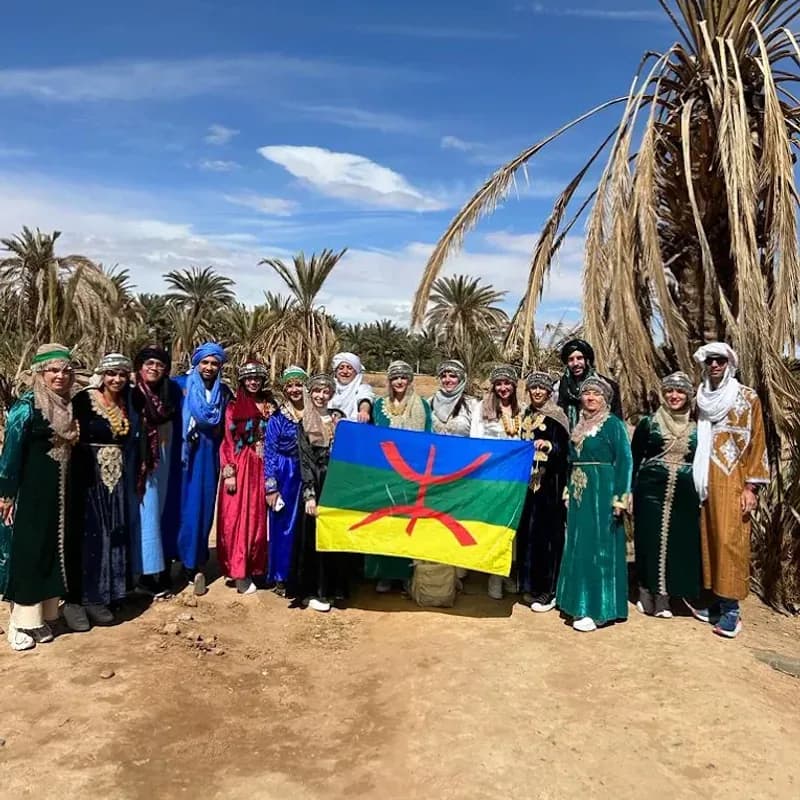
On 14 January Yennayer is celebrated, the Amazigh New Year, which recently became an official holiday across the country. In the villages of the Atlas and the Souss a special couscous with seven vegetables is prepared and there are street celebrations.
At the end of January the Marrakech international marathon is run, starting and finishing near the medina. If you are travelling that week, expect road closures.
February and March
This is almond blossom season. Around Tafraoute, in the Anti-Atlas, an almond festival is traditionally held when the trees flower, between February and March depending on the year.
In spring the International Nomad Festival of M'Hamid El Ghizlane has been held several times, at the end of the Draa Valley road, with Hassani music, camel races and gatherings of nomad families. Its calendar has been irregular, so confirm it beforehand. If it interests you, read our guide to Zagora and the Draa Valley.
In 2027 these months largely coincide with Ramadan, which reduces the number of festivals.
April
In April the Marathon des Sables is run, a multi-day stage race in the southern desert. It isn't a festival, but it fills the Ouarzazate area with runners for a few days.
It is also Easter time, which isn't a holiday in Morocco but fills the country with travellers from Spain and the Americas. If you are coming then, have a look at our Easter trip in Morocco.
May
The Kelaat M'Gouna rose festival is the big event in May. This town in the Dades Valley lives off the Damask rose, which is used to make rose water and rose oil. For a few days there are parades, music, a market of rose products and the election of the rose queen. In 2026 it was held in early May; the date depends on the flowering and changes every year. If you want to include it, the southern route passes through Kelaat M'Gouna on the way to the Dades and Todra gorges.
In some years the Tan-Tan moussem, in the south, also falls in May or June. It is listed by UNESCO as intangible cultural heritage and brings together nomadic tribes from the Sahara with tents, camels, poetry and fantasia. Its dates have changed a lot from one edition to the next, and Tan-Tan is far from the usual routes: about four hours south of Agadir.
June
June is the month of the big music festivals.
The Fez Festival of World Sacred Music brings together musicians from many countries and religious traditions on stages such as the Bab Makina esplanade, next to the royal palace, and in courtyards in the medina. It is usually held between late May and June. It is a good time to combine with a visit to the city; you'll find ideas in what to see in Fez.
The Gnaoua and World Music Festival in Essaouira is the best known outside the country. Gnaoua music has its roots in the peoples of sub-Saharan Africa who came to Morocco centuries ago, and at the festival the Gnaoua masters, the maâlems, play alone or with jazz, blues or African musicians. There are free stages on Moulay Hassan square and by the beach. In 2026 it was held from 25 to 27 June. The town fills up; book accommodation well in advance. For the rest of your visit, see the Essaouira guide, and if you are only going for a day, the day trip to Essaouira from Marrakech.
Rabat hosts Mawazine, an international and Arabic music festival with big concerts. And in Sefrou, near Fez, the cherry festival, also recognised by UNESCO, usually falls in June.
July
The National Festival of Popular Arts in Marrakech brings together dance and music groups from every region of the country, with shows at El Badi palace and parades through the city. In 2026 it was held in early July. It is the easiest way to see the music styles of the whole of Morocco in a few days, from the ahidous of the Atlas to the guedra of the south.
30 July is Throne Day, with flags in every street and official ceremonies.
It is the height of summer and Marrakech is very hot; the shows are in the evening.
August and September
The Imilchil moussem, known as the wedding moussem, is held at the end of August or in September on the plateau of the eastern High Atlas, at over 2,000 metres. Legend has it that two young people from rival tribes were not allowed to marry and wept until they formed the lakes of Isli and Tislit. Today the moussem is mainly a large tribal market lasting several days, with music and a few couples who formalise their engagement. Don't expect a mass wedding like the ones in old photos. Imilchil is far from everything: it is many hours of mountain road from the Todra Valley or from Beni Mellal.
August and September also bring several important moussems, such as the one at Moulay Idriss Zerhoun, near Meknes. In September, Tangier hosts Tanjazz, a jazz festival with concerts around the city.
October
Erfoud, an hour from Merzouga, holds the date festival when the harvest ends, usually in October. There are parades, music, date competitions and a lively market. It fits well with a desert route: most of our tours to Merzouga pass through Erfoud. More information in the guide to Merzouga and the Sahara desert.
In the Draa Valley, M'Hamid hosts the Taragalte festival in some years, with desert music, usually in autumn. In Merzouga, concerts and festivals in the dunes have been organised on very irregular dates; if one interests you, ask us.
November
The Marrakech International Film Festival is held at the end of November or early December, with screenings at the Palais des Congrès and open-air sessions on Jemaa el Fna that anyone can attend.
6 and 18 November are national holidays.
December
December has no big festivals, but Christmas and New Year are among the most requested dates of the year, with many people wanting to see the year out in the dunes. We explain it in New Year in Morocco, and we have a dedicated New Year in the desert programme.
How to plan a trip around a festival
The first thing to know is that many festivals don't publish their dates until a few months beforehand. If the festival is the reason for the trip, wait for them to come out before you buy flights, or buy changeable tickets.
The second is accommodation. During Gnaoua, Essaouira doesn't have beds for everyone, and some people sleep in villages nearby. In Fez, during the sacred music festival, the most popular riads fill up early. Book as soon as you have the dates.
The third is logistics. Rural festivals, like Imilchil, Kelaat M'Gouna or Tan-Tan, are far from the cities and have no easy public transport. To get to one and back onto the main route, a car with a driver saves many hours; we explain this in getting around Morocco.
And the fourth: don't schedule the festival for the last day of your trip. If the date or the programme changes, you are left with no margin.
How to behave at a moussem
A moussem is not a show for tourists. It is a religious pilgrimage and a gathering of families, and the traveller is a guest. Ask permission before photographing people, especially women and in prayer areas, and don't enter the shrine unless you are invited. Dress with shoulders and knees covered.
In the fantasia, the riders charge in a line and fire their gunpowder rifles at the end of the run. Stand where the organisers or local people tell you, never in front of the track or in line with its end. The noise frightens small children, so warn them beforehand.
Carry cash in small notes, because at the moussem market hardly anyone takes cards, and water, as the summer sun is merciless.
Which festival to choose for your dates
If you are coming in spring and doing the desert route, the rose festival fits best, because it is on the way.
If you are coming in June and like music, Essaouira with Gnaoua or Fez with its sacred music festival. You can combine both in one trip if the dates don't overlap, with Marrakech in between.
If you are coming at the end of summer and are interested in rural life in the Atlas, Imilchil, bearing in mind that it is a long journey and that the moussem is by now largely a market.
And if you are coming in autumn, the date festival in Erfoud on your way to Merzouga, or the film festival if you are in Marrakech at the end of November.
If you'd like us to let you know when the dates of a particular festival are published, or to put together a route that takes it in, write to us. You can also see all our events and festivals trips.
Frequently asked questions
What is Morocco's best-known festival?
The Gnaoua and World Music Festival in Essaouira is probably the most famous outside the country. It is held in June, lasts three or four days and fills the town with open-air stages, many of them free. In 2026 it took place at the end of June. Next in fame come the Fez Festival of World Sacred Music and the Marrakech Film Festival.
When is the Kelaat M'Gouna rose festival?
Normally in May, coinciding with the Damask rose harvest in the Dades Valley. The dates change every year depending on the flowering and are announced at short notice. If you want to see it, keep one or two days of your trip flexible and ask us in early spring, when more is known.
Do I need to book ahead to go to a festival?
For accommodation, yes. During Gnaoua, Essaouira fills up and the riads in the medina sell out weeks ahead. Something similar happens in Fez with the sacred music festival. Free concerts don't need a ticket, but paid ones are sold on each festival's official website and some sell out.
Are religious holidays good dates to travel?
It depends on what you are after. During Eid al-Adha and Eid al-Fitr the country stops for one or several days, many shops close and transport is packed. In return you see Moroccan family life on a holiday. If you are on an organised tour, the impact is small; if you are getting around by public transport, it is best to avoid the days just before.