Chefchaouen: what to see and how to get to Morocco's blue town
How to get to Chefchaouen from Fez, Tangier, Tetouan or Casablanca by car or bus, and what to do in the blue town with one day or with two.
Published on · 9 min read
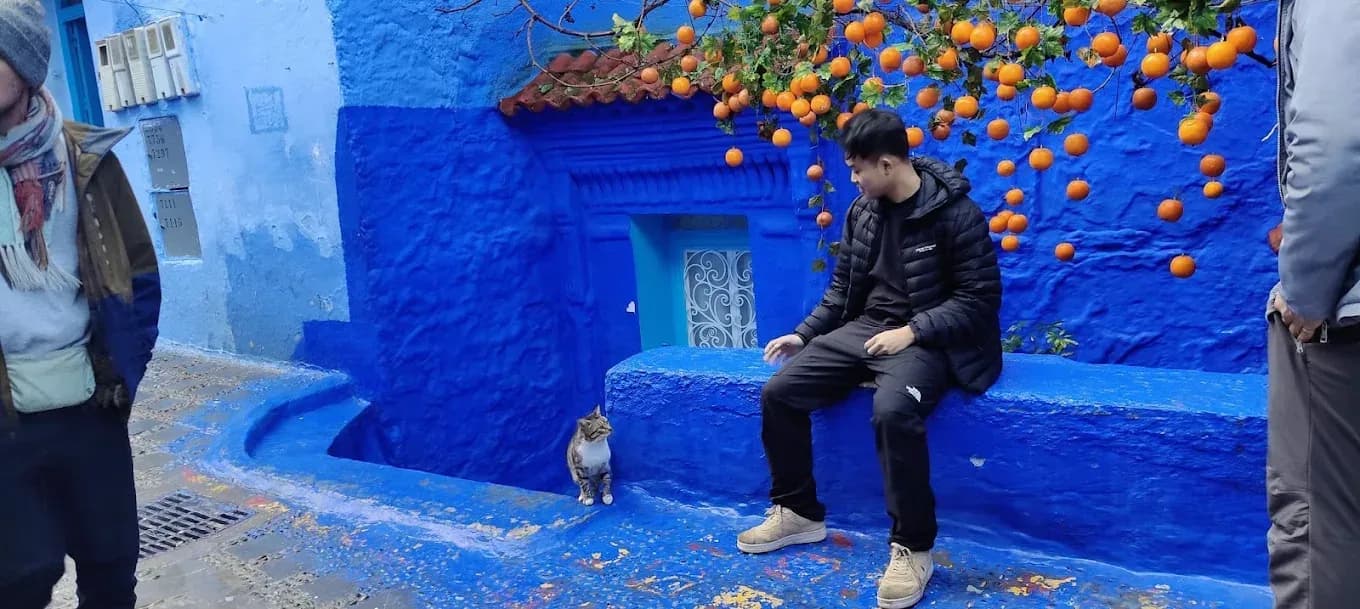
Chefchaouen, the blue town of the Rif, can be seen in a day, but it is far more enjoyable with a night there: that way you get the sunset from the Spanish Mosque and empty streets first thing in the morning. You can only get there by road. It takes about four hours from Fez, about two and a half from Tangier and a little over one from Tetouan, by private car or by bus.
It is one of the most relaxed places in Morocco. Compared with Marrakech or Fez, the sellers hardly push, the pace is slow and the mountain air is fresh for most of the year. What people ask us most before they go is not what to see but how to fit it into the route without losing a day on the road, so we start there. You'll find the quick facts on our Chefchaouen destination page.
How to get to Chefchaouen
Chefchaouen has no airport and no train station. Wherever you come from, the last stretch is a mountain road with plenty of bends. If you get car sick, take something before you set off and tell the driver: he can go more slowly and stop.
From Fez
This is the most common combination. Fez and Chefchaouen are about 200 kilometres apart, which means three and a half to four hours depending on traffic and stops. First you cross plains of olive trees and cereal fields, and the last hour runs through the bends of the Rif.
Our 2-day trip from Fez to Chefchaouen leaves in the morning, arrives mid-afternoon with time to walk up to the viewpoint, spends the night in the medina and returns the next day after an early walk. If you are carrying on north afterwards, we drop you in Tangier instead of going back to Fez.
From Fez you can also stop at Volubilis, the Roman site, and make the journey a longer day, with four to five hours of driving in total.
From Tangier
Tangier is about two and a half hours away, a bit more if you leave from the port of Tanger Med. It is the most practical way in if you arrive in Morocco by ferry from Spain or fly into Tangier. Ferries from Tarifa usually arrive at Tanger Ville and those from Algeciras at Tanger Med, about 45 kilometres from the centre; routes and ferry companies change, so always check official sources before you travel. All the options are in how to travel from Spain to Morocco.
If you have a spare morning, the medina of Tangier, facing the Strait, pairs well with Chefchaouen.
From Tetouan
This is the shortest drive, a little over an hour. Tetouan has a medina of Andalusian heritage, a UNESCO World Heritage Site and far less visited than those of Fez or Marrakech, and it is on the way if you are coming from Tangier or Ceuta. A two-hour stop is enough to walk around it.
From Casablanca or Rabat
From Casablanca it is about five hours by car, and from Rabat four to five. If your flight lands in Casablanca, the logical route is Casablanca, Rabat, Chefchaouen and Fez, then down to the desert or to Marrakech. We don't recommend a same-day return trip to Chefchaouen from Casablanca.
From Marrakech
A day trip to Chefchaouen from Marrakech makes no sense: it is about eight hours or more of driving each way. What we do is build it into a multi-day route through the north, like the one we suggest in Morocco in 7 days, or into a tour such as the 8 days from Tangier to Chefchaouen, Fez and the desert.
By bus
There are public buses from Fez, Tangier, Tetouan and Casablanca. The one from Fez takes a little over four hours. They are cheap, but seats sell out in high season, in summer and at weekends, when many Moroccans also travel north. Buy your ticket in advance on the company's website or at the station. Timetables change with the season, so confirm them beforehand.
Chefchaouen's bus station is in the lower part of town, a few minutes by taxi from the medina. Walking up with a suitcase is a bad idea: it is a long climb.
By shared taxi
Large shared taxis leave from Tetouan and fill up seat by seat before they go. It is the cheapest option and the least comfortable: up to six people in one car, with no fixed departure time. For a solo traveller with a backpack it works; for a family with suitcases, it doesn't.
With a private driver
If you are combining Chefchaouen with other cities in the north, a private driver saves you bus changes and waiting around. The price is per vehicle per day, not per person, so for two or more travellers it works out more reasonable than it looks, and you can stop at Volubilis or Tetouan without depending on timetables.
What to see in Chefchaouen
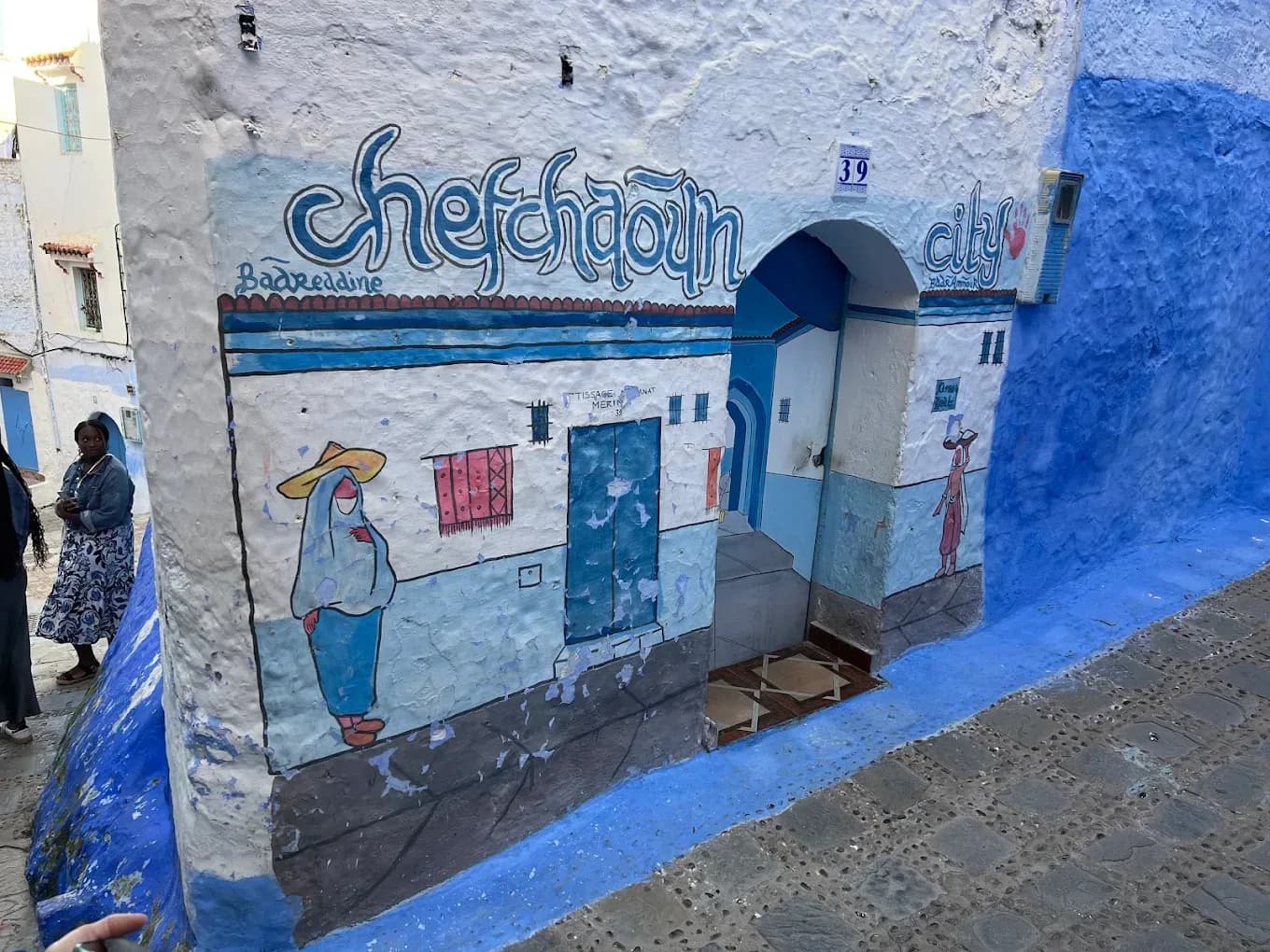
What you come here to do is walk. The medina is small: you can climb from the lower part to Ras el Ma in twenty minutes. But the steep lanes, the stairways, the doors and the flowerpots painted in every shade of blue will make you stop every few metres.
The blue medina
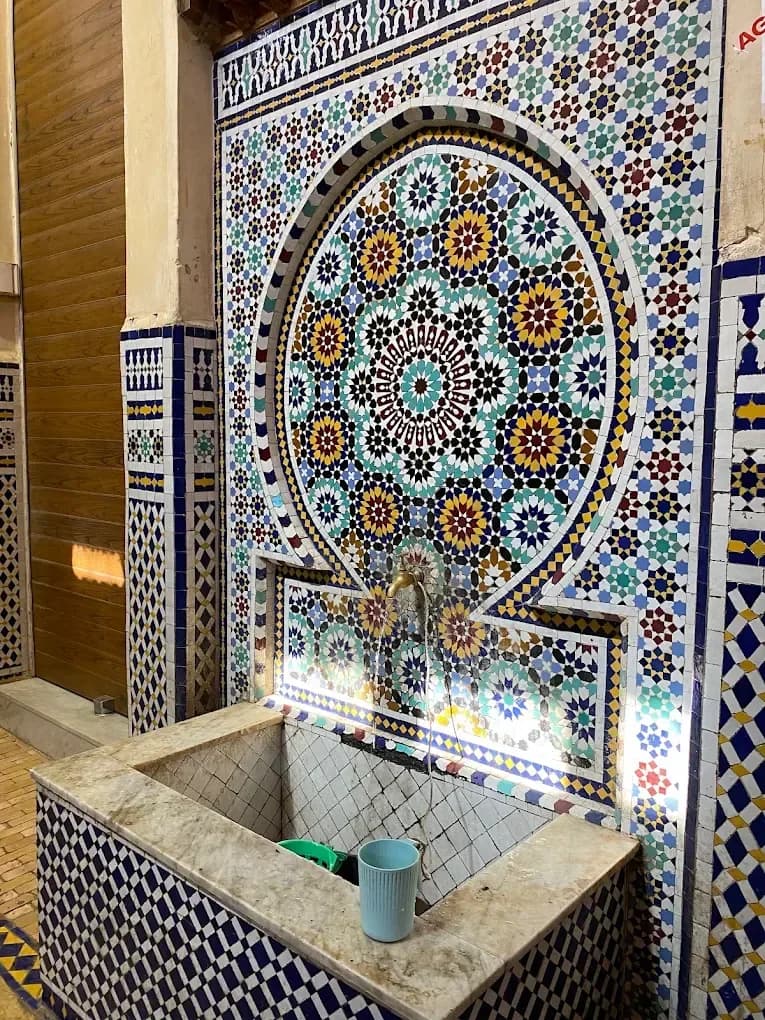
You don't need a plan. Go up and down, step into the small workshops and stop at the neighbourhood fountains. The best-known spots are the stairway lined with flowerpots, the area around the Bab Souk mosque and the lanes of the Sebbanine quarter, one of the oldest. From mid-morning to mid-afternoon the day trips arrive and there is a queue to take the same photo on the same steps.
Outa el Hammam square
The main square, surrounded by cafés and restaurants with terraces. The kasbah and the Great Mosque, with its octagonal minaret, stand here. It is where almost everyone ends up sitting down with a mint tea to watch people go by.
The kasbah
This 17th-century fortress with reddish walls holds a small ethnographic museum and an Andalusian garden. From the tower you can see the square and the rooftops of the medina. You can see it all in three quarters of an hour.
Ras el Ma
At the top of the town, next to the Bab Onsar gate, is the spring that supplies Chefchaouen. You still see women washing clothes at the traditional wash houses; don't photograph them without asking. In summer it is the coolest place in town.
Spanish Mosque viewpoint
From Ras el Ma a path of about twenty to thirty minutes leads to a small mosque built during the Spanish protectorate. It is a short but steep climb, and from the top you get the best view of Chefchaouen. At sunset it fills up, so go up in good time. Take water and a torch, or your phone's, for the way down.
Local crafts
Chefchaouen is known for woollen blankets and garments, Rif textiles and fresh goat's cheese. Prices are usually more reasonable than in the big cities and the haggling is more relaxed.
Chefchaouen in one day
If you really only have one day, for example from Fez or Tangier, leave as early as you can. You'll arrive around midday. Have lunch on the square, visit the kasbah afterwards and walk around the medina in the early afternoon, when the sun is strongest but the groups are starting to leave. Walk up to Ras el Ma and, if you are heading back to Tangier or Tetouan, climb to the Spanish Mosque viewpoint before you leave.
If you are going back to Fez, remember there are another four hours of bends ahead of you. With the sunset and the walk down, you would arrive after dark. In that case we recommend skipping the viewpoint and leaving earlier.
It can be done, and we do it often on private excursions, but to be honest: it is seven or eight hours in the car for three or four in the town.
Chefchaouen with one night
This is what we recommend almost every time. On the first day you arrive mid-afternoon, leave your bag at the riad and walk up to the viewpoint for sunset. You have dinner on the square or on a terrace in the medina.
The next morning you get up early. Between sunrise and roughly nine o'clock the blue streets are yours, in the soft light that suits the colour best. You have breakfast, visit the kasbah and the workshops mid-morning, and leave for your next stop before lunch.
Chefchaouen with two nights
A second night lets you get out into the Rif. The favourite outing is Akchour, a little under an hour away by car, at the entrance to Talassemtane National Park. Two trails start there: one follows the river to a waterfall and the other leads to God's Bridge, a natural rock arch over the canyon. These are walks of several hours with climbs, stones and the odd river crossing. Wear hiking shoes that can get wet and take water and some food. In summer, the very clear pools are the best way to cool off.
Another option is to walk between Rif villages with a local guide, on paths through orchards and woods. If you like walking, have a look at our adventure trips too.
In some parts of the Rif you will be offered cannabis or hashish. Recreational use is illegal in Morocco, so say no politely and carry on.
Chefchaouen depending on who is travelling
For a couple, a night in a riad with a terrace is what they remember most from the north. Ask for a room high up: many terraces look out over the valley.
With children, the town is quiet and safe, but the stairs are tiring. If you have a pushchair, leave it in the car. Some families prefer a hotel with parking in the new town, next to the medina, because the car can pull up at the door.
To anyone coming to take photographs, we say stay two nights to get two sunrises. The blue looks deeper in indirect light or under thin cloud than in the midday sun. If photography is the centre of your trip, have a look at our photography trips.
And if you are short of time, one night here is better than two in Fez with a day spent driving there and back.
Respecting residents and taking photos
Chefchaouen is a lived-in town. Many of the most photographed doors belong to people's homes: don't sit on their steps, don't walk into courtyards or private stairways, and ask permission before photographing people. Many residents prefer not to appear in photos. Some ask for a small tip for posing or for photographing their door; it is reasonable to accept or to walk on without arguing.
When to visit Chefchaouen
Spring, from April to June, and autumn, in September and October, are the best times: mild temperatures and green fields all around. In July and August the town is cooler than the interior, but it fills up with visitors, many of them Moroccans on holiday. In winter it is cold, it rains often and occasionally snows; many small riads are poorly heated, so ask before you book. If you are travelling then, read our guide to travelling to Morocco in winter. Nights are cool for most of the year, so bring an extra layer.
Where to stay in Chefchaouen
Most places to stay are riads and guesthouses inside the medina. Many streets have steps and cars can't get in, so travel with manageable luggage or leave the big suitcase in the vehicle and go up with an overnight bag. Places near Outa el Hammam square are the easiest for getting around on foot.
Chefchaouen on your Morocco route
Chefchaouen fits very well into a route through the north: Tangier, Chefchaouen, Fez and then the Merzouga desert or Marrakech. If this route interests you, see our cultural trips or ask us for a proposal through the contact page, with your dates and the city you are arriving in. We plan the driving times so you reach the blue town in daylight.
Frequently asked questions
What is the best way to get to Chefchaouen?
There is no train or airport, so you always arrive by road. The most comfortable option is a private car from Fez or Tangier, because you stop where you like and the driver knows the bends of the Rif. The public bus is much cheaper, but in high season you need to buy your ticket several days ahead.
Should I sleep in Chefchaouen or is a day trip enough?
We prefer to stay at least one night. On a day trip you spend seven to eight hours on the road for three or four in the town, and you arrive just as the streets are at their busiest. If you stay, you see the sunset from the Spanish Mosque viewpoint and walk the lanes early in the morning when they are almost empty.
Why is Chefchaouen blue?
Nobody knows for sure. The explanation you hear most often points to the Jewish community that settled in the town and used blue as a symbolic colour. Others say it keeps mosquitoes away or keeps the houses cool, and tourism has clearly reinforced the habit. Residents repaint their façades often.
Can you go hiking near Chefchaouen?
Yes. The town sits right in the Rif Mountains. The short walk is the climb from Ras el Ma to the Spanish Mosque. For something longer, Akchour, in Talassemtane National Park, has trails of several hours to waterfalls and God's Bridge. For routes through mountain villages, it is better to go with a local guide.