Money and tipping in Morocco: dirhams, cash machines and haggling
Where to change money, which cash machines to use, when a card works, how much to tip the guide, the driver or the camel handler, and how to haggle without stress, from a local agency.
Published on · 10 min read
In Morocco you pay for almost everything in dirhams and in cash, except accommodation and big purchases. The practical approach is to arrive with a debit card and some euros or dollars, change a little at the airport and take out the rest from bank cash machines in the city. Tipping isn't compulsory, but it is expected, and you should always carry small notes for it.
In our Morocco practical information we cover the basics of the currency, and in how much a trip to Morocco costs we work out daily budgets. Here we go a step further: we follow the money through a normal trip, from the moment you land until you say goodbye to your driver, with rough tipping amounts for each situation. The figures come from what we see every season organising trips and can change with inflation and the exchange rate.
How the dirham works
The currency is the Moroccan dirham, which you'll see written as MAD, DH or Dhs. There are 20, 50, 100 and 200 dirham notes and 1, 2, 5 and 10 dirham coins, plus some centime coins that hardly anyone uses any more. For quick sums, many people divide by ten to get an idea in euros, although recently the euro has been worth a little more than 10 dirhams. Check the day's rate before you leave.
It is a controlled currency. That has two consequences for you. The first is that it isn't easy to buy outside Morocco, so don't waste time looking for it at your bank. The second is that you aren't allowed to leave the country with a lot of dirhams either: according to the Office des Changes regulations we have checked, the limit on dirham banknotes a traveller can bring in or take out is around 2,000 dirhams. Foreign currency can be brought in, but large amounts must be declared at customs on arrival. These rules are reviewed from time to time, so always check official sources before you travel.
The practical upshot is simple: change money as you spend it and don't build up dirhams for the last day.
When you land
At the airports in Casablanca, Marrakech, Fez, Tangier and Agadir there are exchange desks and cash machines in the arrivals hall. They work fine, but the airport rate is usually not the best. Our advice is to change just enough there for the first 24 hours, about 300 or 400 dirhams per person, to pay for a taxi if you have no transfer, a bottle of water and your first dinner.
Ask for mid-sized notes. A wad of 200 notes seems convenient until you try to pay for a 10-dirham tea in a neighbourhood café. If the desk only gives you large notes, ask them to break one or two into 20s and 50s.
Keep the exchange receipt. If you have dirhams left over at the end of the trip and want to change them back at the airport, you may be asked for it.
Cash machines and fees
In the cities there are cash machines on almost every avenue and at the main entrances to the medinas. They accept the usual international cards, especially Visa and Mastercard. What varies a lot from one traveller to another is what their own bank charges for withdrawing abroad, so check your card before you leave. Some debit cards designed for travel charge no fee; others charge a fixed amount per transaction, and then it pays to take out mid-sized amounts a few times.
On top of that, some Moroccan banks charge their own fee on foreign cards, and each machine has a maximum per withdrawal. If a machine offers you a small amount or a high fee, try another bank's machine two streets away.
The detail that loses people the most money is dynamic currency conversion. When the cash machine or card terminal offers to charge you in euros, dollars or dirhams, always choose dirhams. If you choose your own currency, the machine's bank sets the rate, and it is usually quite a lot worse than your own bank's.
Use machines inside a branch or right next to one and, where possible, during the day. If a machine swallows your card during opening hours, you go inside and sort it out on the spot. At night or on a Sunday, it can cost you the rest of the trip.
Where to get cash on the desert route
This is where most travellers get it wrong. Between Marrakech and Merzouga, or between Fez and Merzouga, there are cash machines in Ouarzazate, Boumalne, Tinghir, Errachidia, Erfoud and Rissani. Merzouga has one or two, but few, and they don't always have notes. In the camps in the dunes, of course, there are none.
On our 3-day Marrakech to Merzouga tours we usually stop for lunch or a drink in a town with a cash machine before the last stretch to the dunes. Tell the driver on the first day that you need to get money out and he will find the right moment.
If you are spending more than one night in the desert or doing activities there, such as the camel ride or quad biking, bring the cash from the city.
Card or cash depending on where you are
You'll pay by card without problems in hotels, mid-range and upmarket riads, large supermarkets, motorway petrol stations, better restaurants and fixed-price shops. Some small riads accept cards but add a surcharge, or prefer cash. Ask when you book.
Everything else is paid in cash: taxis, cafés, food stalls, entry to many monuments, car parks, the souks and almost everything you come across in the villages along the way. On Jemaa el Fna square in Marrakech, for example, no juice or snail stall is going to take a card.
Travel with two cards from different networks and keep them in different places. One for everyday use and a back-up in your suitcase or in the safe. If you lose your wallet in the medina, the second card saves your trip.
Euros and dollars
If you bring cash from home, make it euros or US dollars, in clean notes without tears. Exchange offices refuse torn notes or ones with a lot of writing on them. Other currencies, such as the Mexican, Colombian or Argentine peso, can hardly be changed in Morocco at all. If you are coming from Latin America, bring dollars or euros and a debit card; we explain this in more detail in travelling to Morocco from Mexico.
Authorised exchange offices in town usually give a better rate than the airport and many banks, and they don't charge a separate commission. They display the day's rate on a screen at the door. Never change money with someone who stops you in the street offering a better rate.
How much to tip in Morocco
In Morocco, tips make up part of the wages of many people working in tourism. Nobody will demand one rudely, but it is counted on. These are the amounts we give our travellers as a guide when they ask; they are approximate, in dirhams, and you can go up or down depending on how the service was:
- Restaurant with table service: around 10% of the bill, if service isn't included.
- Café or simple stall: round up or leave 2 to 5 dirhams.
- Porter who carries your luggage through the medina to the riad: 10 to 20 dirhams per suitcase, depending on the distance.
- Riad or hotel staff at the end of your stay: 20 to 50 dirhams, in the shared tip box if there is one.
- Attendant who watches your car on the street: 5 to 10 dirhams, more if it is all day.
- Person who cleans the toilets at a petrol station or roadside restaurant: 2 to 5 dirhams.
- Official local guide for half a day in Fez or Marrakech: 100 to 200 dirhams per group.
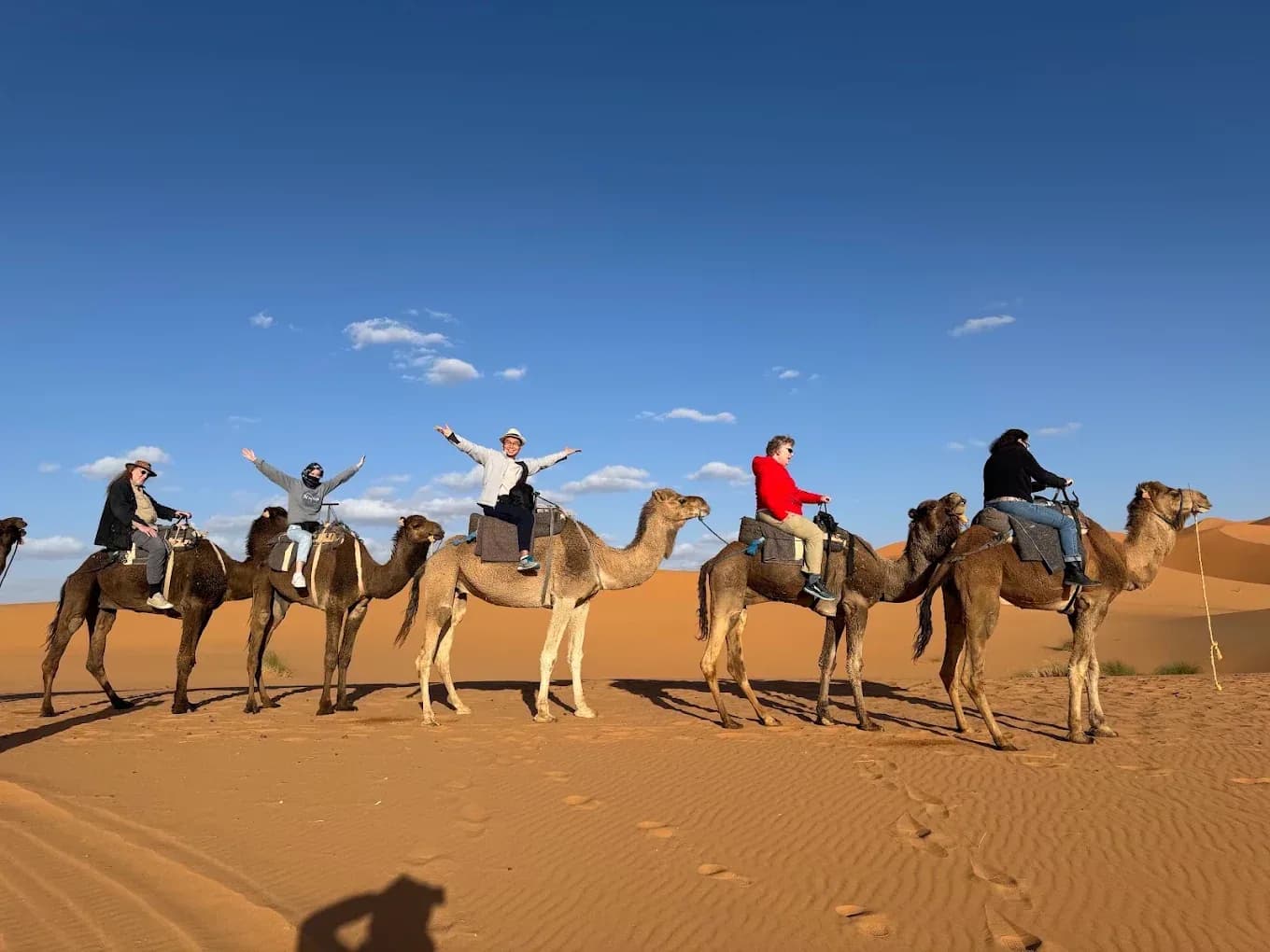
- Camel handler who leads your caravan to the camp: 30 to 50 dirhams per person.
- Desert camp team: 50 to 100 dirhams per person, in one envelope for everyone.
- Driver on a multi-day tour: 100 to 150 dirhams per day, from the whole group.
With a driver and a guide over several days, the usual thing is to give the tip on the last day, in person, when you say goodbye. There is no need to give it every evening. If two couples or a family are travelling together, pool the amount and have one person hand it over; it is easier for everyone.
When you don't need to tip
If someone offers to walk you through the medina without you asking, you don't have to pay them anything, and if you do give them something, others will appear. A "la, shukran" (no, thank you) with a smile and walking on is enough.
For photos with snake charmers, water sellers or musicians on Jemaa el Fna, the money isn't a tip but the price of the photo. Agree the amount before you take out the camera, 10 to 20 dirhams is usually reasonable, because afterwards the figure always goes up.
If the service was bad, you are under no obligation to leave anything. On a trip with us, if something hasn't worked with a driver or a place to stay, we'd rather you told us on WhatsApp at the time so we can fix it.
How to haggle without stress
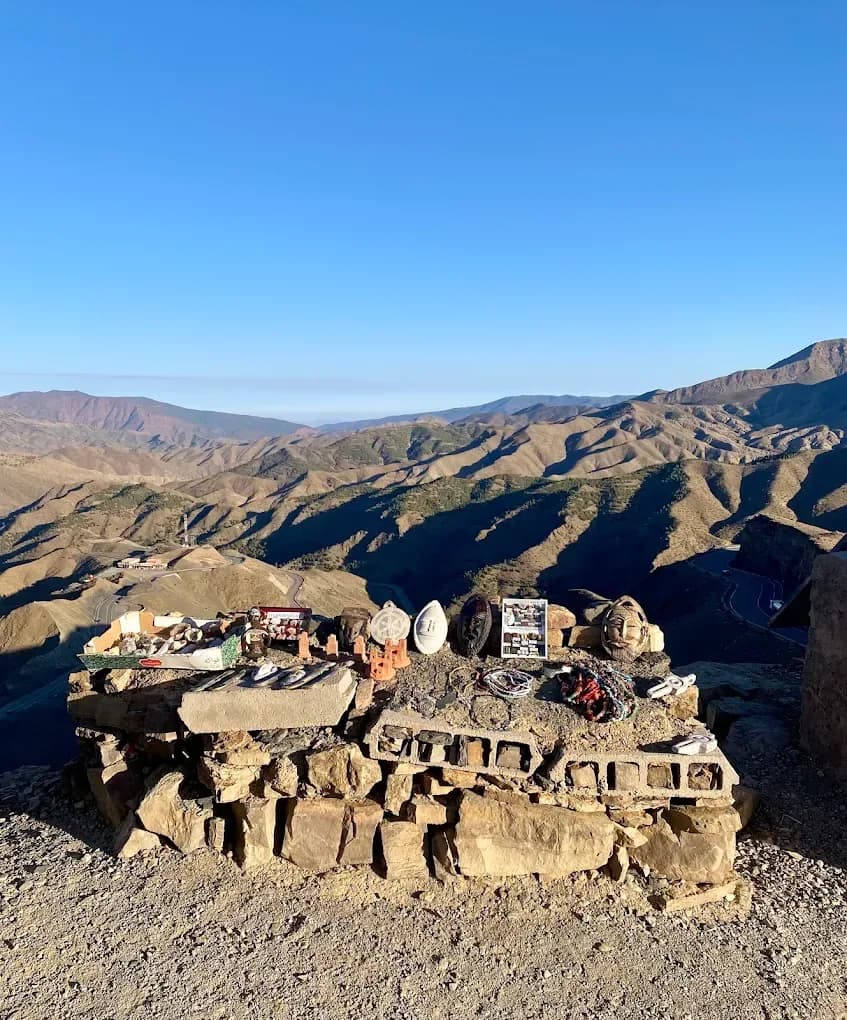
In the souks, the first price is the start of a conversation. You don't haggle in restaurants with a menu, supermarkets, pharmacies, at monument ticket offices or in shops with marked prices.
There is no fixed formula, but it helps to have an order in your head. First, look around several shops without buying to find out what something similar costs. Second, decide how much you'd be willing to pay before you ask the price. Third, when the seller names a figure, reply with one well below it, often between a third and a half, and go up little by little while he comes down. If you can't reach an agreement, say thank you and leave: sometimes the good price turns up when you are already at the door.
Two rules of courtesy. Don't start haggling over something you don't want to buy, because if the seller accepts your figure, you are expected to pay. And don't turn the haggling into a fight over 5 dirhams: for you it is very little, and for him it may be the margin on the sale.
If you don't like haggling, Marrakech, Fez and other cities have fixed-price craft centres, the Ensemble Artisanal, where you can see reference prices before you go to the souk. They are useful even if you end up buying somewhere else.
Rials
In some markets in the south and among older people, prices are still counted in rials, a traditional unit. One dirham equals 20 rials. If someone asks you for 2,000 for a scarf and it sounds outrageous, ask whether that is dirhams or rials: 2,000 rials are 100 dirhams. It is almost always a misunderstanding, not a scam.
Money mistakes we see every season
Arriving with no cash at all, planning to pay for everything by card. The first taxi, the first coffee and the porter in the medina are paid in dirhams.
Changing your whole budget at the airport. You lose on the rate and then you can't take leftover dirhams out of the country.
Paying with 200 notes at small stalls. The seller has no change, goes off to find some and you wait twenty minutes.
Accepting the charge in euros at the card terminal or cash machine. It looks clearer, but it costs more.
Leaving your spare dirhams for the departure airport. Spend them before, on the last dinner or on water and food for the flight, or change them back with the receipt in hand.
Carrying all your money in the same pocket. In the medina, keep part in your wallet and part in an inside pocket or in the riad safe.
How you pay for a trip with us
Our prices are in euros. To confirm a booking we ask for a deposit that is deducted from the total, and the rest is paid as agreed; we explain the payment methods when we send you the quote. On private tours the price includes the vehicle with a Spanish-speaking driver and the accommodation with the meals listed in each programme. What usually isn't included, such as lunches, drinks, some entrance fees, optional local guides and tips, is paid in cash along the route. For a tour like the 8 days through the imperial cities and the desert, budget for that extra cash from day one.
If this is your first trip, the rest of the practical information is in the Morocco travel guide, and the packing list is in what to pack for Morocco. When you have dates, write to us and we'll send you a fixed quote showing what is included and what you'll pay separately, so you know how much cash you need before you leave home.
Frequently asked questions
Can I buy dirhams at home before I travel?
In practice, hardly ever and not at a good rate. The dirham does not circulate freely outside Morocco, so banks abroad rarely sell it. The sensible approach is to arrive with euros or dollars and a debit card, change a small amount at the airport and withdraw or change the rest once you are in the city.
How much cash should I carry each day?
In a city, for meals, drinks, taxis and tips, between 300 and 600 dirhams per person is usually enough, in 20, 50 and 100 notes. Big purchases, like a rug or a lamp, are paid for separately and sometimes by card. Keep the rest of your money in the safe at your riad or hotel.
Is the driver's tip given per person or per group?
Normally the group puts an amount together and hands it over at the end of the trip, in person and in an envelope if you prefer. As a rough guide, many travellers reckon on 100 to 150 dirhams per day of the tour for the driver, from the whole group. It is not compulsory and depends on how the trip went.
Can you pay in euros in Morocco?
Some shops in tourist areas and certain desert camps accept euros, but the exchange rate they apply almost always works against you and your change comes back in dirhams. For day-to-day spending it is better to pay in local currency. Accommodation and agencies, on the other hand, usually quote prices in euros.
Are there cash machines in Merzouga?
There are one or two in the village, but they are few, sometimes run out of notes and you shouldn't count on them. Withdraw money beforehand in Ouarzazate, Tinghir, Errachidia or Erfoud, depending on your route. At the camp any extra drinks are paid in cash, and it is where you give the tip for the team.